Emergency lighting in schools: the monthly test that keeps getting missed
Emergency lighting is the escape route's insurance policy: when the power fails, it is what turns a dark corridor full of children into a lit one. The duty flows from the fire safety order: the Regulatory Reform (Fire Safety) Order 2005 requires emergency routes to have lighting that works when the normal supply fails. BS 5266 turns that into a rhythm any school can run: a short monthly function test of every luminaire, an annual test for the full rated duration, and a log that shows both happened and what was done about the failures. It is among the cheapest compliance regimes in the building, and among the most commonly lapsed, because the monthly test has no contractor attached: it lives or dies with the site team's routine.
The emergency lighting year
The intervals come from BS 5266 (with BS EN 50172): brief and monthly for function, annual for duration, everything recorded.
| Check | What happens | Who | Record |
|---|---|---|---|
| Monthly function test | Simulate mains failure (test key or switch); walk the route; every luminaire and exit sign lights; restore and confirm charging | Site team | Log entry per test: date, circuit or zone, failures found |
| Annual full-duration test | The same, held for the full rated duration, three hours for most systems, then batteries confirmed recharging | Site team or contractor; many schools pair it with the alarm service | Certificate or log entry with duration, results, remedials |
| Defect close-out | Failed fittings and flat batteries replaced promptly: an emergency light that fails its test is not spare capacity, it is a dark spot on an escape route | Site team or electrician by fitting type | Defect logged, job raised, completion dated |
The log book is the compliance
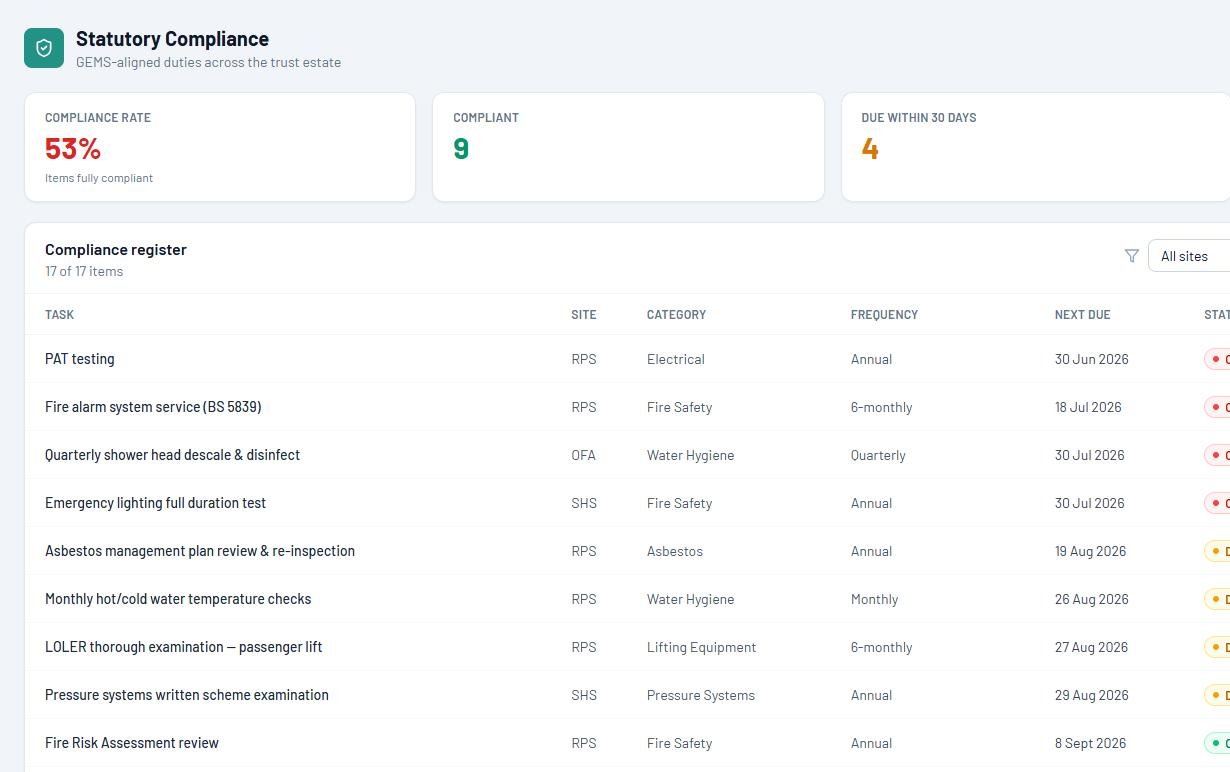
Fire officers rarely ask whether a school has emergency lighting; they ask to see the test log. A complete one reads as a rhythm (twelve monthly entries, one duration test, defects raised and closed), and it is precisely the kind of recurring, evidenced routine that belongs on the planned schedule with a date against it rather than in someone's memory. The annual compliance calendar slots the duration test into the holidays, where a three-hour discharge and a slow recharge cannot leave routes under-protected on a school day.
The monthly test also earns its keep as a walk: the person with the test key sees the propped fire door, the blocked exit and the dead corridor lamp on the same circuit. Schools that badge it as part of the weekly-and-monthly fire routine, alongside the alarm call-point test in the statutory checklist, get four checks for the price of one walk.
One design note worth knowing: an annual test discharges the batteries, which is why BS 5266 points it at times of least risk. Holiday afternoons exist for this. Term-time mornings do not.
Emergency lighting: the questions that come up
What does the law actually require?
The Regulatory Reform (Fire Safety) Order 2005 requires emergency routes and exits to be provided with emergency lighting of adequate intensity where needed, and, like everything under the Order, requires the system to be maintained in efficient working order. The intervals themselves come from the standard, BS 5266 with BS EN 50172: a monthly function test and an annual full-duration test, both recorded. The Order sets the duty; the standard sets the rhythm; the log proves both.
Can the site team do the tests, or do we need a contractor?
The monthly function test is squarely a site team job: a test key or switch, a walk of the route, a log entry. The annual duration test can also be done in-house on many systems, though plenty of schools fold it into the fire alarm service visit so an engineer confirms the results and handles failed fittings on the spot. What matters is not who holds the test key but that the tests happen on schedule and the failures get fixed.
Why does the annual test have to be three hours?
Because that is what the system is rated to do, and a rating is only real if it is demonstrated. Most escape-route systems are specified for three hours precisely so a building can be evacuated and, where needed, re-entered under battery light. A monthly flick-test proves the lamp lights; only the full-duration test proves the ageing batteries still hold the claim printed on the fitting. Batteries degrade silently: the duration test is where that is caught.
What if fittings fail the test?
Log the failure, raise the fix, and treat the spot it guards as unprotected until the fitting works, which for an escape route means the repair is prompt, not eventual. Most failures are batteries at end of life or lamps, both quick jobs. The audit failure mode is not the dead fitting; it is the log that shows the same fitting failing three months running with nothing done.
Monthly tests on the rota, the log that writes itself
Function tests scheduled monthly with evidence captured at the point of work, the duration test in the holidays, failures tracked to close-out, in your school's own Microsoft 365. Call 020 4558 7729 or email info@estateproof.co.uk.