The annual compliance calendar for schools: what's due when
A school's compliance year has two layers. Underneath, the constant drumbeat that never varies: weekly alarm tests, monthly water temperatures and lighting checks, termly drills. On top, the annual and longer-cycle items that have to land somewhere, and because most of them run twelve months from last completion rather than to fixed statutory dates, where they land is a choice. Good estates teams make that choice once, deliberately, around the shape of the school year. This guide maps the sensible version, month by month from September, with the trap months flagged.
The drumbeat that never stops
Before placing anything annual, respect the base load: it runs every month of the year, term time or not. Weekly: a fire alarm call point (rotating), fire door and escape route walk-checks, playground equipment visual. Monthly: emergency lighting function tests, sentinel water temperatures, extinguisher visuals. Termly: an evacuation drill varied by time and scenario, and a health and safety walk.
Two things about this layer decide whether the whole calendar works. First, holidays don't pause it: water monitoring in an empty August building matters more, not less. Second, it's your own site team's rhythm, which means it survives on habit and dies on absence: the register should show who's covering the weekly test when the site manager is on leave, not discover the gap in September. The full list, with evidence requirements, is on the printable checklist.
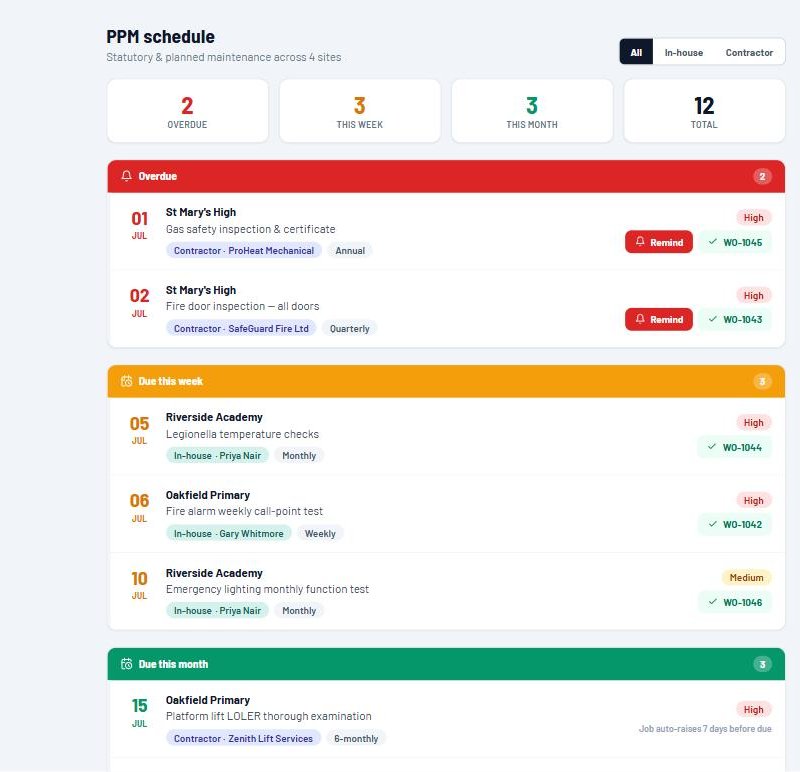
Anchoring the annual items: a sensible year
Twelve-month cycles anchor wherever you choose. This is a defensible default, built around occupancy, seasons and contractor availability; adjust to your contracts and region.
| Month | Anchor here | Why here |
|---|---|---|
| September | Post-summer water flushing and temperatures; pre-term H&S walk; early-term evacuation drill; playground annual inspection | Six weeks of low water use is the legionella danger point; new pupils have never heard your alarm; playgrounds face a year of hard use |
| October | Fire alarm service #1 (half-term); fire door inspection #1; heating up to full service before the cold | Half-term gives contractors an empty building; heating failures found in October beat failures suffered in January |
| November | Asbestos re-inspection and management plan review | Quiet stretch between half-term and Christmas; surveyor access is easier in term-time low-traffic areas than you'd think |
| December | Emergency lighting full-duration test (Christmas break) | The three-hour discharge test wants an empty building and dark evenings to matter |
| January | Fire risk assessment review | Calendar-year anchor is easy to remember; findings feed the spring works planning round |
| February | LOLER thorough examination #1 (half-term); PAT programme starts | Lifts examined while empty; PAT works around classes over several weeks, so start early |
| March / April | Gas appliance service and safety check (Easter); extinguisher service | End of heating season: findings can be fixed before boilers matter again; Easter gives the access window |
| May | Condition walk feeding summer works list; legionella risk assessment review | Summer works tenders need a survey behind them, and May is the last sensible moment to write the list |
| June | Summer works contracts confirmed; contractor insurance/DBS renewals checked before the holiday influx | The firms on site in August are booked, and vetted, in June |
| July / August | Summer works window: EICR phases, fire door inspection #2, fire alarm service #2, LOLER #2, anything disruptive | The only weeks the building is truly yours, which is why every contractor in the county is booked; schedule by Easter |
The trap months: September (everything restarts at once while you're busiest) and August (maximum works, minimum staff, and a water system stagnating). Whatever else moves, protect the post-summer flushing and the June contractor-vetting pass. Build the dated version for your own estate with the free compliance calendar tool, and count the total workload with the PPM forecast calculator.
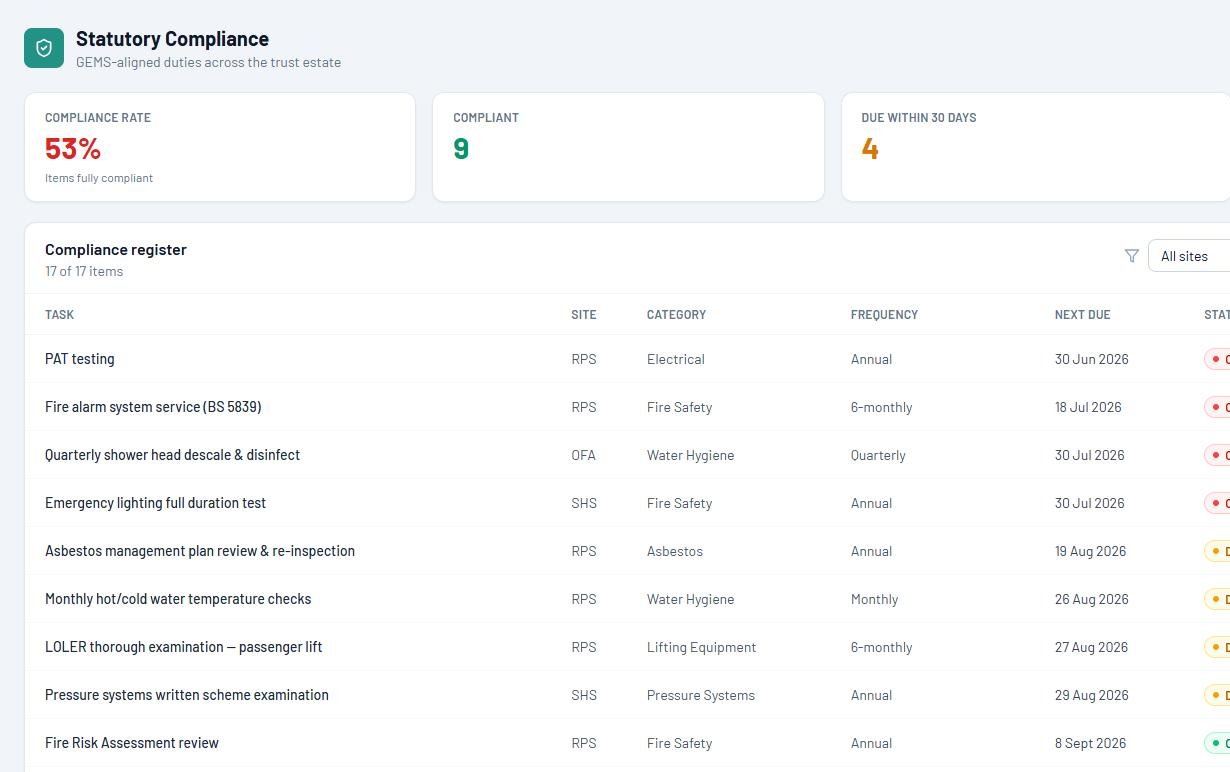
Calendars don't fail. They drift.
Nobody decides to move the gas service from April to July. It happens one slip at a time: the contractor cancels, the rebooking lands six weeks later, and because the next service runs twelve months from completion, the anchor has moved, out of the Easter access window and into term time, permanently. Three years of small slips and the tidy calendar above is unrecognisable, with the disruptive visits landing in the busiest weeks.
The defence is lead time and chasing: contractors reminded well before the visit falls due, escalation when a booking slips, and the anchor month treated as the target rather than wherever last year happened to finish. That discipline is exactly what scheduling software automates (the case is made in our planned maintenance software guide), but the principle costs nothing: book next year's anchor visits before this year's are cold.
About the compliance year
Do the annual compliance items have fixed statutory dates?
Very few. Most annual duties (gas safety, emergency lighting duration tests, asbestos re-inspection) run twelve months from the last completion, so the school chooses the anchor. That's the opportunity: anchor them to sensible points in the school year once, and the calendar defends itself thereafter. The trap is drift: every late completion moves the anchor into a worse month.
Why does September matter so much?
Because the summer break is the estate's riskiest gap: six weeks of low water use ahead of legionella-sensitive systems restarting, dormant buildings coming back to full occupancy, and a new cohort who've never heard your fire alarm. Post-summer flushing, pre-term checks and an early-term evacuation drill belong at the top of the September list.
When should contractor-led work be scheduled?
Wherever pupils aren't. Half-terms and holidays are the natural windows for noisy or disruptive visits: fire alarm servicing, fire door inspections, EICR phases. That is exactly why contractors book up early for them. Schedule with a term of lead time and chase before the visit falls due, not after it slips.
Is there a version of this calendar for my own estate?
Two free ones: the interactive compliance calendar builds the year around your own choices, and the printable statutory checklist puts the full duty list on the site office wall. When the estate outgrows both, the same schedule runs itself in software: jobs raised ahead of due dates, contractors chased, the calendar rolling forward automatically.
A calendar that chases, so you don't
See the whole year running itself in the live demo: jobs raised ahead of due dates, contractors reminded, anchors held. No sign-in needed. Call 020 4558 7729 or email info@estateproof.co.uk.