PAT testing in schools: intervals, myths and the register
Portable appliance testing is the compliance duty most surrounded by folklore. The law, the Electricity at Work Regulations 1989, never mentions PAT, never sets an interval, and never demands a sticker on every plug: it requires electrical equipment to be maintained so as to prevent danger, and leaves the how to you. The recognised how is the IET Code of Practice: a blend of user checks, formal visual inspections and combined inspection-and-test, at intervals set by risk (the class of the equipment, the environment it lives in, and how roughly it gets handled). A kettle in the staff room and a glue gun in DT are not the same problem. This guide sets out a defensible school regime and the register that evidences it.
A defensible interval table for a school
Benchmarks in the spirit of the IET Code of Practice: a starting point to adapt by risk assessment, not a rulebook. The point is that the intervals are yours, reasoned, and written down.
| Equipment & environment | User check | Formal visual | Combined inspection & test |
|---|---|---|---|
| DT, science & catering equipment: hard use, harsh environment | Before use | Termly | Annually |
| Site team power tools & extension leads | Before use | Termly | Annually |
| Classroom & office equipment that moves: laptops on carts, projectors, fans | Informal | Annually | Every 1 to 2 years by condition |
| Fixed-in-place IT & double-insulated kit: desktops, monitors, printers | Informal | Annually | Longer intervals defensible; visual inspection does most of the work |
| Staff-owned & donated items |
The register does more than the tester
A PAT regime stands on its record: an inventory of appliances, each with a location, an interval, a last-tested date and a result, plus the failures and what happened to them. The sticker on the plug is a convenience; the register is the evidence. Most testing contractors will hand over a spreadsheet after the visit, and the schools that stay compliant are the ones that file it where next year can find it, with the failed items tracked to disposal or repair rather than back into a cupboard.
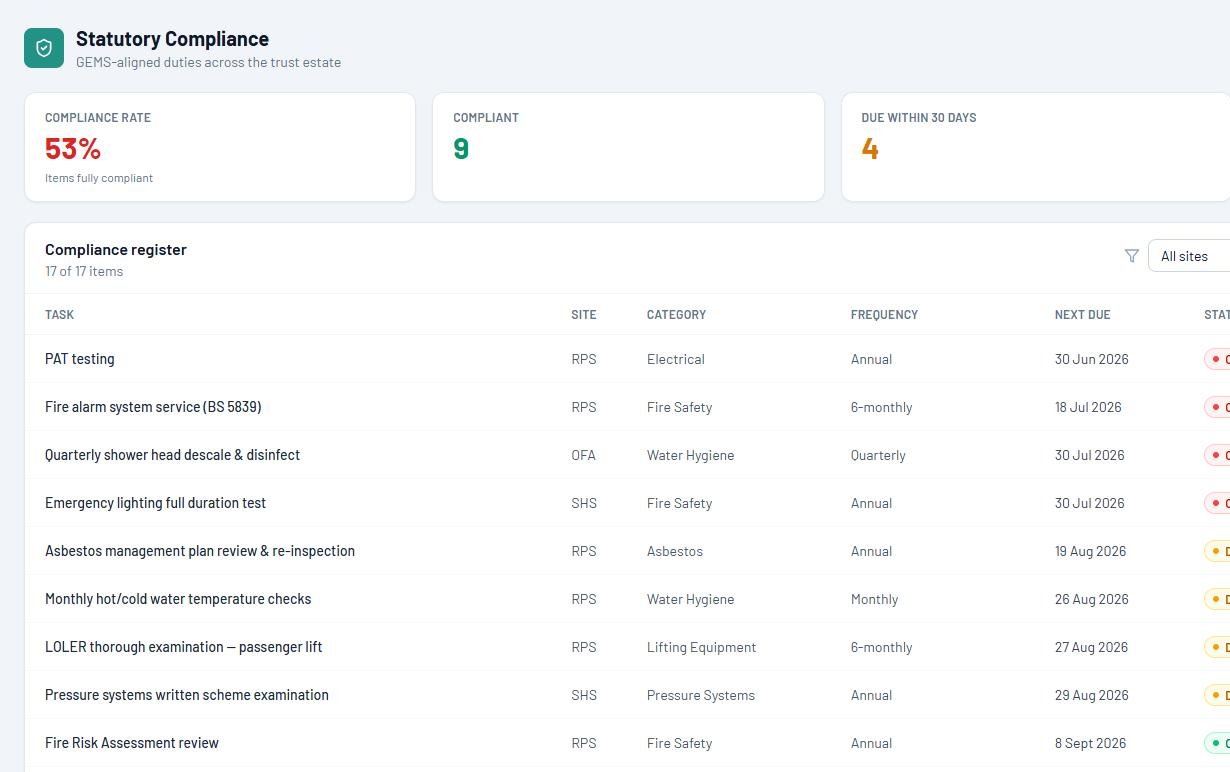
The intervals themselves belong in the planned schedule like any other recurring duty: visible, dated, chased when they slip. That is exactly how the statutory checklist treats them. And PAT is the portable half of a pair: the fixed installation has its own five-yearly cycle with its own close-out discipline, covered in the EICR guide.
One cultural point pays for itself: teach staff the user check. Most dangerous defects (crushed leads, cracked plugs, taped-over damage) are visible to anyone who looks, months before any tester calls. A staffroom that unplugs and reports beats a regime that relies on one annual visit.
PAT testing: the questions that come up
Is annual PAT testing a legal requirement?
No. No law names PAT testing or sets an interval. The Electricity at Work Regulations 1989 require equipment to be maintained to prevent danger; the IET Code of Practice translates that into risk-based inspection and testing, with intervals that vary by equipment class and environment. Annual-for-everything is neither required nor best practice: it over-tests low-risk kit and can under-test the workshop. What is expected is a reasoned regime, applied and recorded.
Who can carry out PAT testing?
A competent person, which the Code frames as someone with the right knowledge, training and equipment for the level of work. Formal visual inspections can sit with a trained member of staff; combined inspection and test needs someone trained on the test instrument and able to interpret results, which for most schools means either a trained site team member or a testing contractor. Competence is about the person, not a mandatory qualification badge.
Do brand-new appliances need testing?
Not usually. New equipment should be safe as supplied, and a visual check that it is undamaged and correctly rated is enough to put it into service. What it does need, immediately, is a place on the register with an interval assigned, so it joins the regime rather than orbiting it. The same gate applies to donated and staff-owned items, which arrive with no such presumption of safety and have caused more than their share of incidents.
What should happen when an item fails?
It comes out of service the same day: labelled, removed from the room, and its fate recorded (repaired and retested, or disposed of). The register should show the failure and the close-out, because the classic audit finding is not a missed test but a failed item that reappeared in a classroom three weeks later. Failure handling, not test coverage, is where PAT regimes are genuinely judged.
Every appliance, every interval, one register
PAT cycles on the schedule by risk, results filed against the site, failures tracked to close-out, in your school's own Microsoft 365. Call 020 4558 7729 or email info@estateproof.co.uk.