The EICR, explained: electrical safety without the jargon
Of all the school compliance duties, electrical safety hides best: nothing looks more compliant than a wall socket. The Electricity at Work Regulations 1989 require electrical systems to be maintained so danger doesn't arise, and for the fixed wiring the evidence is the EICR: the Electrical Installation Condition Report, done on a five-yearly cycle in most schools, coded like an MOT and capable of turning into a six-figure remedial programme. This guide translates the cycle, the codes, the unsatisfactory verdict and the close-out trail, so the next report is a document you manage rather than one that manages you.
The codes, in plain English
An EICR reads like an MOT for the building's wiring: observations, each with a classification code, and the codes decide everything about what happens next.
| Code | What it means | What happens next |
|---|---|---|
| C1 | Danger present: risk of injury, now | Made safe before the contractor leaves site. No scheduling conversation. |
| C2 | Potentially dangerous, urgent remedial action required | Scheduled with real urgency, tracked to completion, certificate filed |
| C3 | Improvement recommended, not a fault | The only code that doesn't affect the verdict. Judged on merit, often batched into planned works. |
| FI | Further investigation required without delay | Booked promptly: an FI is a question the inspector couldn't answer, not a pass |
Any C1, C2 or FI makes the overall report unsatisfactory, and an unsatisfactory report is a work list with a clock on it, not a filing event.
The report is the easy half
Schools rarely miss the EICR itself: a contractor turns up every five years and a PDF arrives. The failure mode is the close-out: the report lands in an inbox, the C2s get a quote, the quote waits for a budget meeting, and eighteen months later nobody can say which remedials were done. An unsatisfactory report with no completion evidence is the worst document in the filing cabinet, because it proves the school knew.
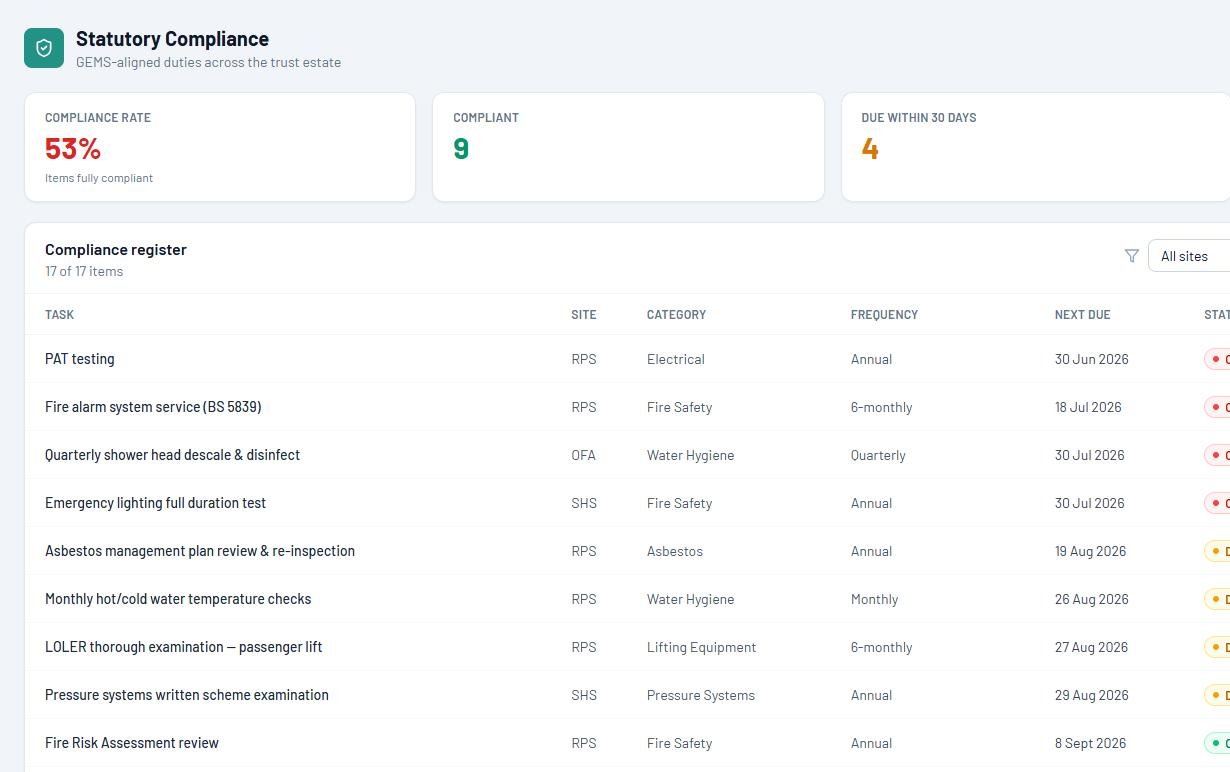
The close-out trail is simple to describe: each C1, C2 and FI raised as its own job, assigned, costed, completed, and closed with its certificate attached, with the register showing, at any moment, what remains open from the last report and when the next one falls due. That's the shape EstateProof gives it: findings tracked as jobs against their school, evidence filed where the next person can find it, in your own Microsoft 365. The statutory compliance software guide covers the wider register this sits in.
And because five-yearly duties are precisely the ones that outlive staff tenure, the EICR is the poster child for records that survive handover, the argument made in the new site manager's checklist. Where it sits in the year: the annual compliance calendar.
The EICR: the questions that come up
How often does a school need an EICR?
The working benchmark for educational establishments is a maximum of five years between inspections of the fixed electrical installation, drawn from IET guidance under BS 7671, though the previous report can recommend a shorter interval, and that recommendation is the one that counts for your buildings. The legal foundation is the Electricity at Work Regulations 1989, which require electrical systems to be maintained so as to prevent danger; the EICR is how you demonstrate the fixed wiring side of that duty.
What do the C1, C2, C3 and FI codes mean?
C1 means danger present: risk of injury, immediate action required, and a contractor should make it safe before leaving site. C2 means potentially dangerous, urgent remedial action needed. C3 means improvement recommended: not a fault, and the only code that doesn't affect the overall verdict. FI means further investigation required without delay. Any C1, C2 or FI makes the whole report unsatisfactory.
The report came back unsatisfactory: what now?
An unsatisfactory EICR is not a failure event; it is a work list with a clock on it. C1s get made safe immediately, C2s and FIs get scheduled with real urgency, and each remedial gets its own completion certificate. The mistake that turns a routine report into a liability is the gap: an unsatisfactory report on file with no evidence the remedials happened is worse in front of an auditor or insurer than the defects themselves, because it shows you knew.
Does the EICR cover kettles, laptops and workshop equipment?
No. The EICR covers the fixed installation: the boards, circuits, wiring and accessories. Portable and movable equipment falls under in-service inspection and testing (what most people still call PAT), which current IET guidance treats as risk-based rather than a blanket annual test: a caretaker's power tools and DT workshop machines on a shorter cycle than an office monitor. The two regimes are separate lines on the compliance register, with separate evidence.
From unsatisfactory report to closed-out evidence
Findings raised as jobs, remedials tracked to completion, certificates filed against the school, in your own Microsoft 365. Call 020 4558 7729 or email info@estateproof.co.uk.