Planned maintenance software: the schedule that runs itself
Planned preventative maintenance is a simple promise made hundreds of times a year: the gas boiler gets serviced before its certificate lapses, the legionella temperatures get taken monthly, the fire alarm gets tested weekly, and none of it depends on one person's memory. Planned maintenance software keeps that promise at scale: scheduling every recurring task at its proper frequency, raising the job before it falls due, chasing the contractor, and rolling the schedule forward the moment work completes. The stakes have risen, too: the DfE's School Estate Management Standards treat reactive-only maintenance as no longer adequate, and from autumn 2026 every responsible body self-assesses against that expectation annually.
A calendar reminds. A schedule engine acts.
Most schools already have a "PPM schedule", a spreadsheet with months across the top, rebuilt every September, wrong by November. The failure isn't effort; it's that a spreadsheet can only remind. It cannot raise the job, chase the contractor, capture the certificate, or move the next due date when the work is done. Every one of those steps falls back on a person, and people have terms like everyone else.
A scheduling engine does the acting itself. In EstateProof, each planned task carries its frequency (weekly, monthly, quarterly, termly, annual, up to five-yearly) and the system raises the work order ahead of the due date, assigns it to the in-house owner or contractor, sends the instruction, and on completion rolls the task forward to its next occurrence automatically. Contractors are reminded before a service falls due, chased when it slips, and asked for renewed insurance or DBS documents as expiry approaches. The schedule stops being a document somebody maintains and becomes a process that maintains itself.
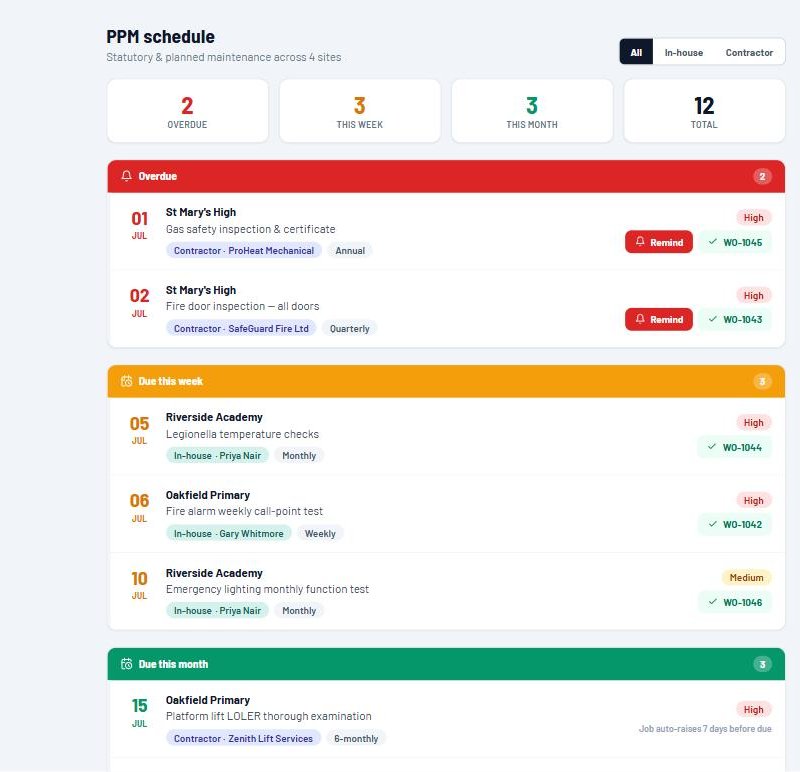
Where the frequencies come from
The recurring cycle behind a school estate. These should be seeded in the system on day one and corrected to what your service contracts actually specify, not built from a blank template.
| Task | Typical frequency | Driven by |
|---|---|---|
| Gas appliance service & safety check | Annual | Gas Safety (Installation and Use) Regulations 1998 |
| Fixed electrical installation (EICR) | Five-yearly | BS 7671; Electricity at Work Regulations 1989 |
| Fire alarm: call points / service | Weekly / six-monthly | BS 5839-1, supporting RRO 2005 |
| Emergency lighting | Monthly function test; annual duration test | BS 5266-1 |
| Legionella monitoring | Monthly temperatures; risk assessment kept live | ACOP L8 / HSG274 |
| Asbestos re-inspection | Typically annual | Control of Asbestos Regulations 2012 |
| Lifts carrying people | Six-monthly thorough examination | LOLER 1998 |
| Playground equipment | Weekly visual; annual main inspection | Sector practice (BS EN 1176) |
The statutory duties behind these lines are covered duty by duty in our guide to school compliance software. For what the workload costs when it slips, the free cost-of-reactive calculator is uncomfortably persuasive.
How to choose planned maintenance software
Eight questions that separate scheduling engines from calendars with aspirations.
Does completion roll the schedule forward automatically?
If somebody rebuilds the schedule every September, you've bought a document, not a system.
Are the statutory frequencies seeded on day one?
Gas, EICR, fire alarm, lighting, legionella, asbestos, LOLER: present at the right frequencies before anyone touches a template.
Is the job raised before the due date?
With enough lead time for a contractor to actually book the visit: a monthly light test and a five-yearly EICR need very different notice.
Are contractors chased automatically?
Reminders ahead of due, escalation when it slips, and insurance and DBS renewals requested without anyone remembering, in the same system, not a separate spreadsheet of expiry dates.
Does the certificate land on the record?
The gas safety certificate belongs on the job that produced it, retrievable years later, not in an inbox.
Can in-house and contractor work share one schedule?
Each seeing only what's theirs, with the estates lead seeing everything.
Does overdue statutory work escalate visibly?
On the dashboard the head and the trust actually look at, not in a report someone has to remember to run.
Do you know what the backlog costs?
Deferred maintenance compounds. Put numbers on your own estate with the free PPM budget forecast calculator before a boiler does it for you.
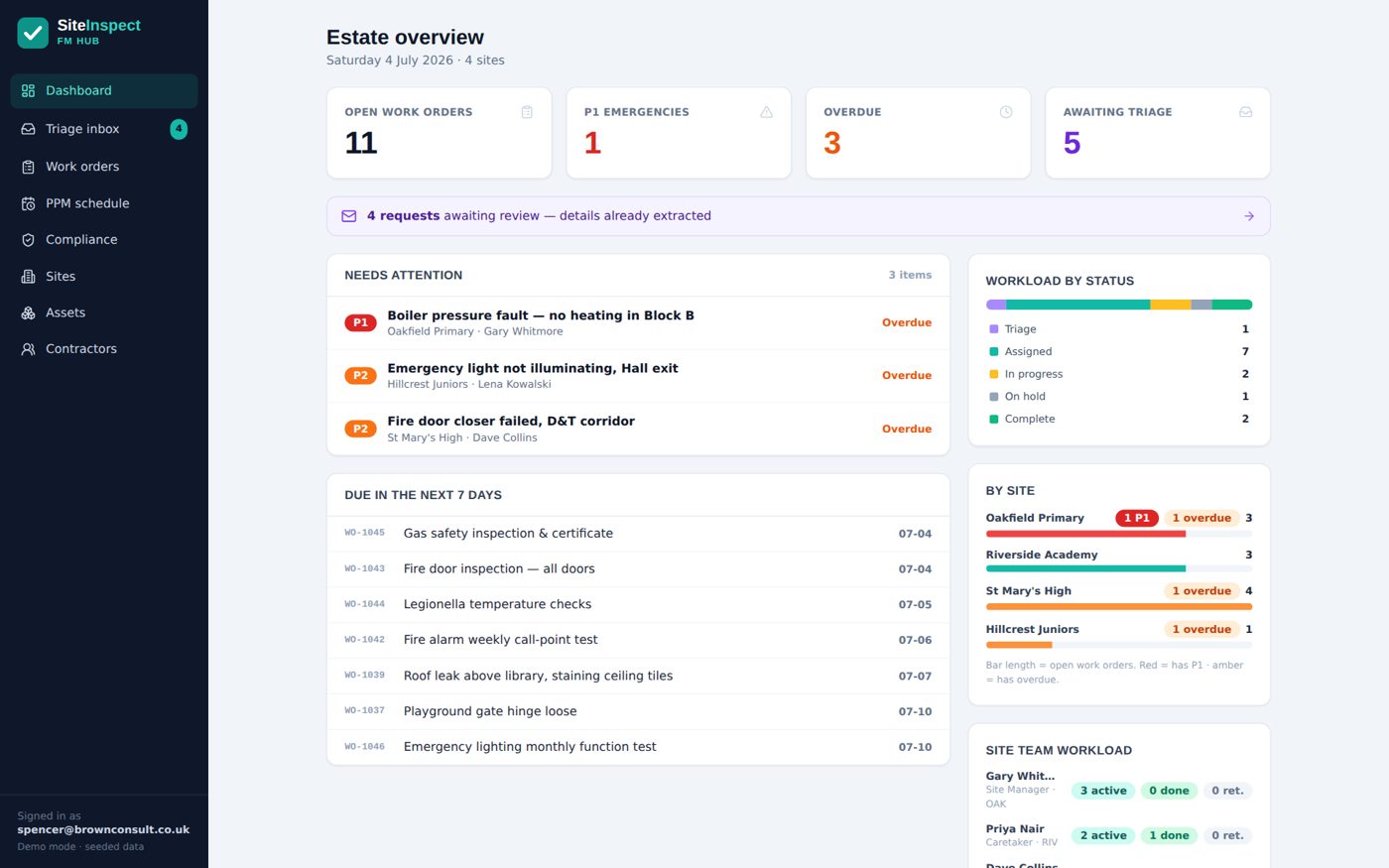
The schedule is also a forecast
A live PPM schedule is the raw material for the budget conversation: what's due this year, what it costs, and what happens if it slips. Boards that see planned works phased across the year approve budgets differently from boards shown one alarming total in March. And under the DfE's standards, forward maintenance planning prioritised by condition and risk is precisely what "fully effective" estate management looks like.
The free PPM budget forecast calculator gives you the starting numbers in a few minutes; the system keeps them honest thereafter, because the schedule and the spend live on the same records. For the whole-estate picture beyond maintenance, see our guide to estates management software for schools.
What does it cost?
Published, per site per year, ex VAT, unlimited users, banded 1 to 3, 4 to 10 and 11+ sites. The scheduling engine is in every tier.
Silver From £650 per site per year
FMProof: the full PPM engine, fault reporting, work orders, site team app, contractor portal and leadership dashboard. The tier this page is about.
Gold From £1,150 per site per year
Adds InspectProof: digital inspections and checklists, AI email and photo triage, and the safety screen.
Platinum From £1,650 per site per year
Adds GovernanceProof: board packs, e-signed approvals and policy publishing, on the same records as the estate.
Per site per year, ex VAT, at the 11+ band; smaller estates pay more per site. Price your estate in 30 seconds, or see EstateProof configured for multi-academy trusts and schools.
Questions buyers actually ask
What is planned maintenance software?
A system that holds every recurring maintenance task, statutory and routine, at its proper frequency, raises the work order ahead of the due date, assigns it to your site team or a contractor, and rolls the schedule forward automatically when the work completes. The alternative is a spreadsheet that reminds but cannot act.
What's the difference between PPM and reactive maintenance?
Reactive work responds to faults after they happen; planned work prevents them and keeps statutory duties in date. Every estate needs both: the point is the ratio. The DfE's estate management standards treat reactive-only maintenance as inadequate practice, and deferred planned work tends to resurface as emergency spend.
Are the statutory frequencies built in?
In EstateProof, the standard school cycle (gas annual, EICR five-yearly, fire alarm weekly and six-monthly, emergency lighting monthly, legionella monthly, asbestos re-inspection, LOLER) is seeded at onboarding and corrected to what your service contracts actually specify. You edit frequencies and last-done dates; you don't build the schedule from scratch.
How do contractors fit in?
Each planned task can belong to an in-house owner or a contractor. Contractors are reminded before a service falls due, chased when it slips, and asked for renewed insurance or DBS documents as expiry approaches, automatically. Their completed work and certificates land on the same record as everything else.
What does planned maintenance software cost?
The scheduling engine is part of every EstateProof tier, from £650 per site per year ex VAT (Silver), with unlimited users. Gold (from £1,150) adds digital inspections and AI triage; Platinum (from £1,650) adds governance. Bands at 1 to 3, 4 to 10 and 11+ sites mean larger estates pay less per site.
See the schedule run itself
Thirty minutes, no hard sell: the PPM engine working on an estate like yours. Or open the live demo now, no sign-in needed. Call 020 4558 7729 or email info@estateproof.co.uk.