The asbestos management plan, explained for schools
Of every duty a school estate carries, asbestos is the one where the paperwork most directly protects people. The Control of Asbestos Regulations 2012 place a duty to manage on whoever is responsible for the building's maintenance, and in a sector where most buildings pre-date the 2000 ban, that means most schools. This guide explains what the duty actually requires in plain terms: the survey, the register, the plan, the re-inspections, and the communication rule that prevents most incidents. It's a working explainer, not a substitute for the HSE's guidance or a competent surveyor, but it should leave you knowing exactly what to ask both.
What the duty to manage actually asks
Find out. Establish whether asbestos-containing materials are, or may be, present. For pre-2000 buildings the safe presumption is that they may be, unless a management survey says otherwise. Know where they are and what condition they're in.
Write it down. Keep a register of known and presumed materials (location, type where known, condition) and assess the risk each presents. Undisturbed material in good condition is usually a candidate for managing in place, not removal.
Plan it. The management plan says how each item will be managed: monitored at set intervals, protected or sealed where needed, removed where condition demands it, with named responsibility and dates.
Keep it alive. Re-inspect recorded materials (annually is the common benchmark), update the register and plan with findings, and review after any damage or building work. A plan last touched three years ago is a liability wearing a lanyard.
Tell people. The part that prevents incidents: anyone who might disturb the fabric (your own site team, every contractor) sees the register before work starts, every time.
What a working management plan contains
Not a template to fill once: a live document the estate actually uses. The test of each part is the question it must answer under pressure.
| Part | What it holds | The question it must answer |
|---|---|---|
| The register | Every known and presumed material: location, extent, condition, last inspected | "Contractor's drilling in Room 12 at 8am, what's in that wall?" |
| Risk assessments | Material and priority assessments per item | "Which items need action this year, and which are safe to monitor?" |
| The management decisions | Manage in place, protect, seal or remove, per item, with owner and date | "What did we decide about the boiler house lagging, and who owns it?" |
| Re-inspection schedule | Condition reviews of recorded materials, typically annual | "When was each item last looked at, and by whom?" |
| Communication procedure | How the register reaches staff and contractors before work, and how sight of it is recorded | "Can we prove the roofer saw the register before Tuesday?" |
| Emergency procedure | What happens if material is disturbed: stop work, isolate, assess, inform | "A ceiling tile just came down, who does what in the next ten minutes?" |
| Survey records | Management surveys; refurbishment & demolition surveys before invasive works | "We're refurbishing the science block, is a management survey enough?" (No.) |
Before any refurbishment or demolition, the more intrusive refurbishment-and-demolition survey is required for the affected areas; a management survey doesn't license invasive work. Full HSE guidance sits under the Control of Asbestos Regulations 2012 and its Approved Code of Practice; your surveyor should be working to it without being asked.
Plans don't fail in the filing. They fail at the drill bit.
Most school asbestos incidents are mundane: a contractor fixes a whiteboard to a wall nobody mentioned, a caretaker lifts a floor tile to trace a leak, a Saturday job goes ahead because the person who holds the register wasn't in. The survey was done; the plan existed; the communication step failed.
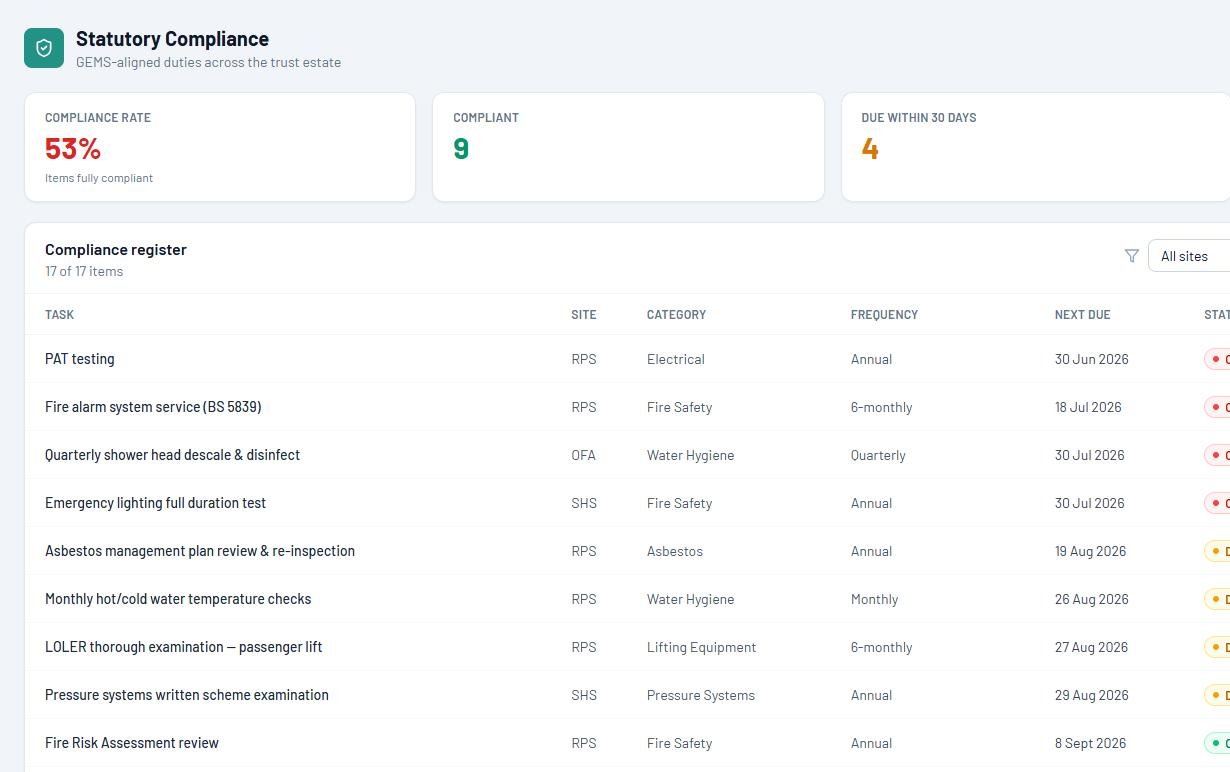
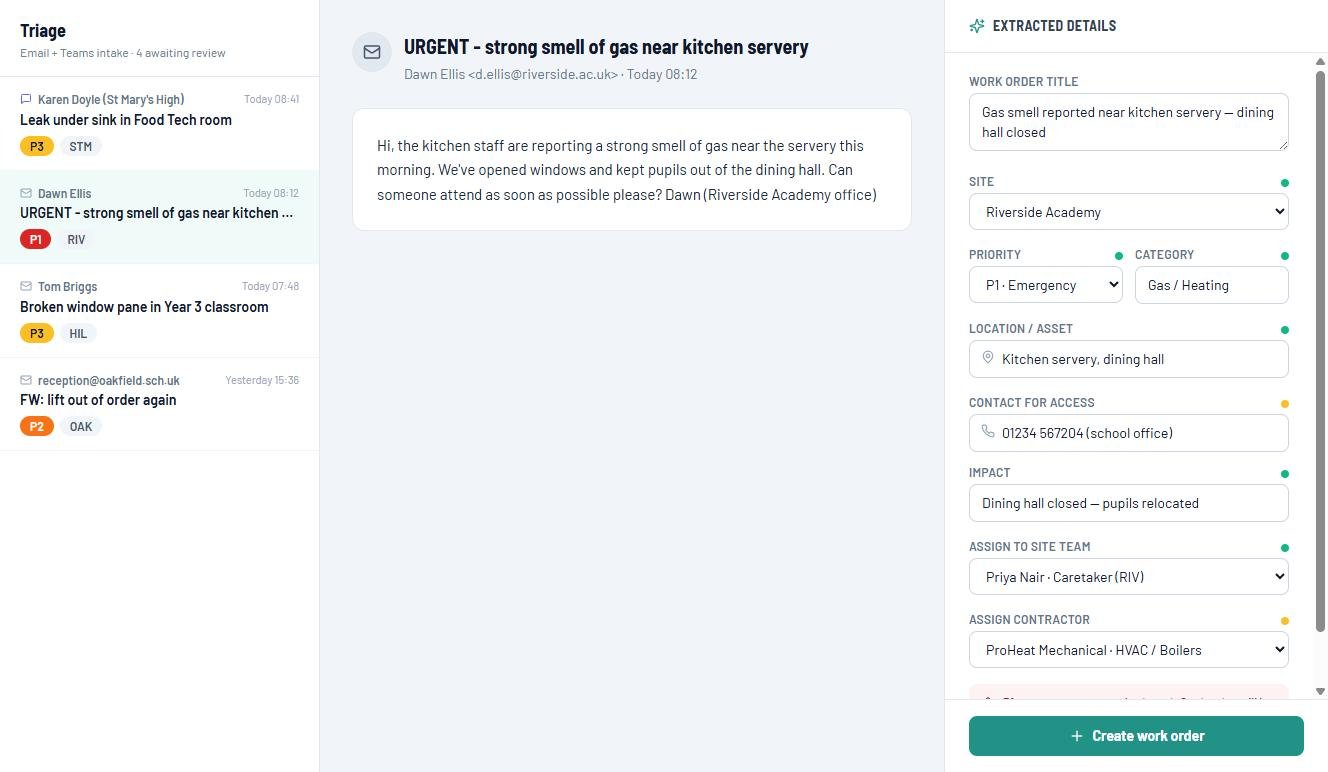
Which is why the practical fix is workflow, not paperwork: the register check belongs at the point where work is raised, not in a folder someone might remember. In EstateProof, jobs carry the site and location the moment they're created, so "check the register before invasive work at this location" becomes part of how work is instructed, and the re-inspection itself runs on the same planned maintenance schedule as everything else, with the surveyor chased before the anniversary rather than after it. Where the plan and register live matters too: in your own tenant, retrievable in seconds, which is the argument of our school compliance software guide.
Asbestos in schools: the questions that come up
Does our school definitely contain asbestos?
If any part of the building was constructed or refurbished before 2000, the working assumption under the regulations is that asbestos-containing materials may be present unless a survey shows otherwise, and a large share of the school estate falls into that category. In-place, undisturbed and in good condition, those materials are generally managed rather than removed; the risk is disturbance, which is what the management plan exists to prevent.
Who is the duty holder in a school?
Whoever has responsibility for maintenance and repair of the premises, in practice the employer: the trust for academies, typically the local authority for community schools, the governing body for voluntary-aided schools. The duty can't be delegated away by hiring a surveyor; consultants inform the plan, but the duty holder owns it.
How often should the asbestos register be re-inspected?
The regulations require the condition of known materials to be reviewed and the plan kept up to date; annual re-inspection of recorded materials is the widely adopted benchmark, with sooner reviews after any damage, disturbance or building work. The re-inspection is only half the job: the register and plan must be updated with what it finds.
What's the single most important rule?
Nobody drills, cuts, fixes or lifts anything in a pre-2000 building without checking the register first, staff and contractors alike. Most school asbestos incidents aren't exotic: they're a contractor putting a screw through a panel nobody showed them the register for. The plan's communication step is the one that prevents them.
Put the register where the work happens
See how the asbestos schedule, the register and the jobs that must respect it live on one set of records, in your school's own Microsoft 365. Call 020 4558 7729 or email info@estateproof.co.uk.