Contractor induction in schools: the pack that protects everyone
A contractor walking into a school steps into two rulebooks at once: health and safety law, which makes the school and the contractor jointly responsible for the work being done safely, and safeguarding, which makes the school responsible for who is on site while children are. A good induction is not a form for the sake of a form: it is the ten minutes that puts the asbestos register in the electrician's hand before the drill comes out, establishes whether the visitor needs a DBS check or an escort, and gets the emergency basics across. This guide sets out what the pack should contain, where the safeguarding lines actually sit, and the trail that shows it happened.
The induction pack, item by item
Before the visit: the vetting. On arrival: the induction. During: the supervision the vetting decided. Every item below earns its place.
| Item | What it establishes | When |
|---|---|---|
| RAMS review | The contractor has thought about this job, on this site: method, risks, controls | Before the visit is booked in |
| Insurance & competence | Public liability current; trade registrations where the law names them (Gas Safe, certificated electricians, licensed asbestos work) | At approval, re-checked on expiry |
| Safeguarding status | DBS check where the work is regulated activity; otherwise supervision arrangements: the school decides, not the contractor | Before arrival |
| Sign-in & identity | Who is on site, badge worn, host named, and signed out at the end | On arrival, every visit |
| Asbestos register acknowledgement | The contractor has SEEN the register entry for their work area and signed to say so, before any intrusive work | On arrival, before work starts |
| Permits where the work demands them | Hot works, roof access, isolations: time-bounded, named, closed off after | Issued per task |
| Emergency basics | Alarm sound, assembly point, first aid, who to find when something changes mid-job | In the induction, every first visit |
The induction is only real if it is recorded
Everything in the pack produces a record: the reviewed RAMS, the insurance expiry dates, the DBS decision, the signed asbestos acknowledgement, the permit with its close-out, the sign-in trail. Kept per contractor rather than per drawer, that file answers the two questions that follow any incident: did the school check, and can it show the check happened before the work did.
The asbestos acknowledgement deserves its own sentence: the single most preventable exposure route in school maintenance is a tradesperson drilling into a surface nobody showed them the register for. The asbestos management plan guide covers the register itself; the induction is where it meets the person holding the drill.
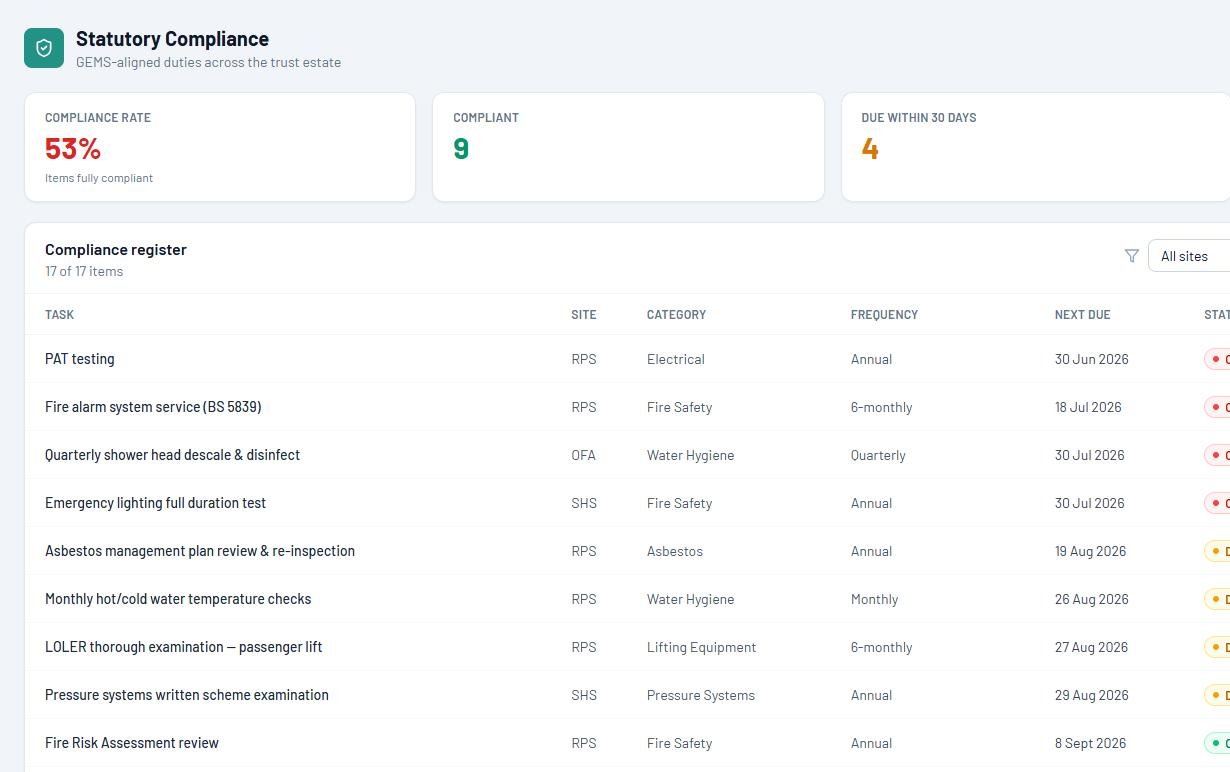
Expiry is the quiet failure mode: insurance and DBS positions age silently. A per-contractor record with dates on it turns renewals into a diary event rather than a discovery, which is the same discipline the statutory checklist applies to certificates. And for what the visiting trades actually do at height, the working at height guide picks up where the induction leaves off.
Contractor induction: the questions that come up
Does every contractor need a DBS check?
No, and getting this right matters in both directions. The test is regulated activity: broadly, work that involves regular or unsupervised contact with children. A contractor doing occasional maintenance during the school day, supervised or escorted, will not normally meet it; a contractor working unsupervised on a regular pattern may. Where a check is not in place, the school's control is supervision, and the decision, either way, should be the school's own recorded judgement per Keeping Children Safe in Education, not the contractor's assurance.
What is the asbestos acknowledgement and why is it non-negotiable?
Before any intrusive work in a pre-2000 building, the contractor must be shown the asbestos register entry for their work area and sign to confirm they have seen it. It is the control that stands between a routine job and an exposure incident, drilling, cutting or lifting into a surface the register flags. No signature, no start: it is the one line in the induction where being awkward is the job.
When does a job need a permit rather than just an induction?
When the work carries a hazard that outlives or exceeds the person doing it: hot works that can smoulder into a fire hours after the blowtorch leaves, roof access where a fall is unforgiving, isolations of gas, electricity or water that others rely on. A permit is a short, time-bounded authorisation naming the person, the task, the controls and the close-out check. If the school has never issued one, hot works is the place to start; it is the permit insurers ask about first.
Who is responsible if a contractor works unsafely?
Both parties, in law and in practice. The contractor owns their method and their people; the school owns the premises, the information handed over (asbestos register, fragile roofs, site rules) and the reasonable checks that the contractor was competent for the job. That is why the induction file matters: the school cannot stand over every ladder, but it can show it selected, informed and controlled access like an organisation that takes the duty seriously.
Every contractor vetted, inducted and on file
Insurance and DBS expiry tracked per contractor with renewals chased automatically, inductions and permits filed against the visit, in your school's own Microsoft 365. Call 020 4558 7729 or email info@estateproof.co.uk.