Working at height in schools: ladders, roofs and the register
More site staff are hurt falling from height than by anything else they do, and the law reflects it: the Work at Height Regulations 2005 apply to every task where a person could fall and be injured, which in a school means the display going up in the hall, the gutter clear, the flat roof inspection and the Christmas lights, not just the contractor on the scaffold. The regulations ask for three things in strict order: avoid working at height where you can, prevent falls where you can't avoid it, and reduce the consequences where you can't prevent them. This guide turns that hierarchy into a school-sized regime: what your own team may do, what goes to a contractor, and the ladder register that holds it together.
Who does what at height, and with what kit
The dividing line isn't bravery, it's planning: short-duration, low-risk tasks with the right equipment sit with the site team; everything else is a planned job.
| Task | Sensible arrangement | The paperwork |
|---|---|---|
| Displays, light bulbs, high shelves | Site team with a step ladder or podium steps, never a chair, never a desk | Ladder on the register, pre-use check by the user, periodic detailed inspection logged |
| Gutters & gullies at eaves height | Site team from a suitable ladder with a second person footing, or from a tower, task risk-assessed either way | Risk assessment on file; ladder inspection current; the clear itself logged as the planned task it is |
| Flat roof access | Restricted: named, trained people only, edge awareness, never alone, never in poor weather | Roof access procedure; permit or sign-out for each visit; fragile areas marked on the plan |
| Fragile roofs & rooflights | Nobody from the school goes near them; a contractor with crawling boards or coverings, full stop | Fragile surfaces identified on the site plan and flagged in the contractor induction |
| High-level maintenance, trees, MEWP work | Contractor with the right access equipment and trained operators | RAMS reviewed before the visit; operator tickets (e.g. IPAF) checked; insurance current |
The ladder register is the spine
Every ladder and stepladder the school owns belongs on one list: an identity, a location, a condition, a last-inspected date. Users do a quick pre-use check every time (feet, stiles, rungs, locking bars), and a competent person does a recorded detailed inspection periodically, with three-to-six-monthly a common benchmark depending on use. Damaged kit is tagged and removed the day it fails, not at the next inspection.
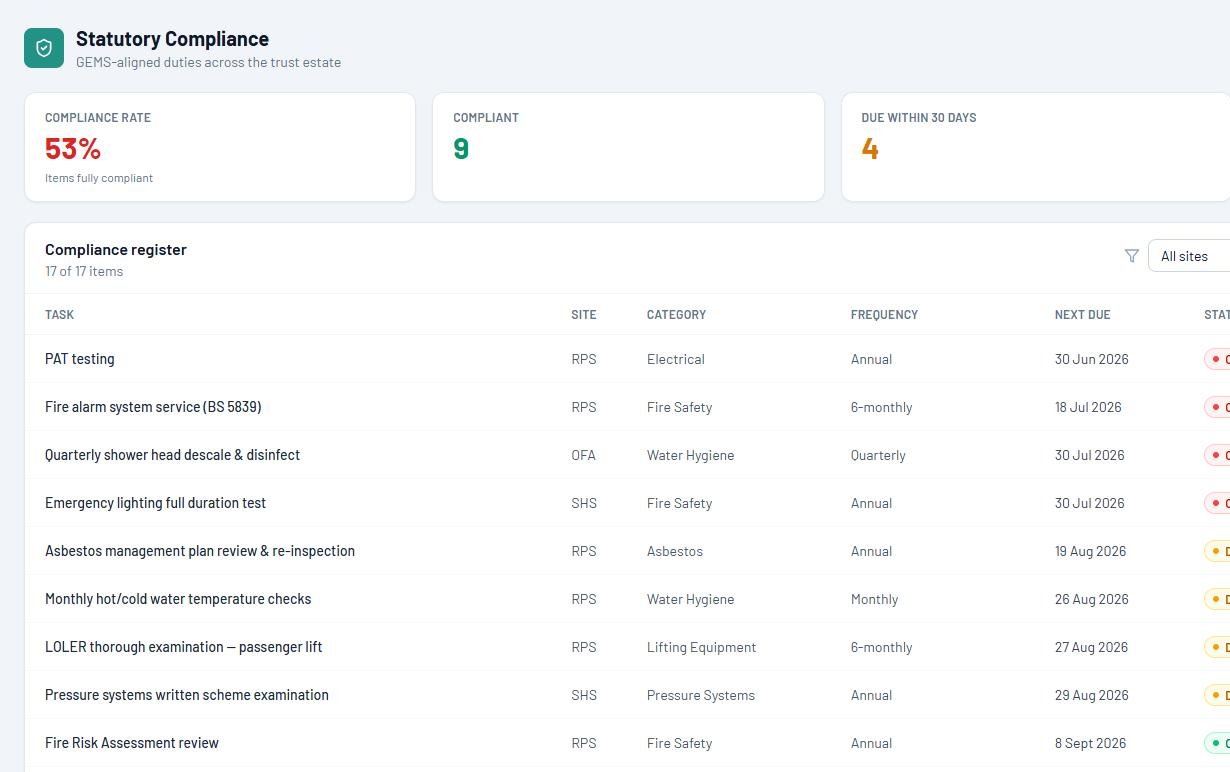
The register earns its keep the day something happens: it is the difference between "we take equipment seriously and here is the trail" and a drawer of receipts. Filed with the risk assessments and the roof access log, it sits naturally alongside the rest of the statutory checklist evidence: same discipline, same one-place rule.
Two neighbouring guides finish the picture: the contractor induction guide covers the visiting trades who do the height work you should not, and the new site manager checklist puts the ladder register in week one, where it belongs.
Working at height: the questions that come up
Do the Work at Height Regulations really apply to a stepladder?
Yes. The regulations apply wherever a person could fall a distance liable to cause injury; there is no two-metre threshold, and stepladders are squarely in scope. That does not make stepladders banned: it makes them equipment to be used where the task is short-duration and low-risk, by someone who knows how, on kit that is maintained and checked. The chair, the desk and the windowsill are what the regulations actually rule out.
How often should ladders be inspected?
Two rhythms. A pre-use check by the person using the ladder, every time: a minute on feet, stiles, rungs and locking mechanisms. And a recorded detailed inspection by a competent person at a set interval; many schools work to three or six months depending on how heavily the kit is used. The interval is yours to set by risk assessment: what matters is that it is set, kept to, and written down per ladder.
Can the caretaker go on the roof?
Sometimes, and only by design, never by default. A sound flat roof with safe access, for a planned task like a gutter or outlet check, can be within a trained site team member's reach under a roof access procedure: named people, sign-out, edge awareness, never alone, never in bad weather. Fragile roofs and rooflights are different in kind: they fail without warning, they kill experienced tradespeople, and nobody from the school should be on or near them. If a roof's condition is unknown, treat it as fragile until a survey says otherwise.
What records would an inspector expect to see?
The working-at-height risk assessments for your routine tasks; the ladder register with its inspection trail; the roof access procedure and its sign-out log; training records for the people you allow at height; and for contractors, the RAMS you reviewed before the visit. The pattern across all five is the same: not paperwork for its own sake, but evidence that height work in your school happens on purpose rather than on improvisation.
Ladder checks scheduled, roof visits logged, one file
Routine height checks on the schedule, inspections evidenced at the point of work, contractors inducted with the record to show it, in your school's own Microsoft 365. Call 020 4558 7729 or email info@estateproof.co.uk.