The estate self-assessment return: how to be ready before it's mandatory
The DfE refreshed its Estate Management Standards in June 2025, and the Education Estates Strategy published in March 2026 turned the dial: from autumn 2026, responsible bodies submit an annual self-assessment return against those standards. For schools that already run a tidy estate, the return is an afternoon's work. For everyone else, the first one is an archaeology project, because the questions aren't hard, but the evidence lives in eleven places. This guide covers what the standards ask, who should own the answer, and the preparation that makes next autumn boring in the best way.
What the return will draw on
The standards read less like a technical inspection and more like a test of organisational memory: does the responsible body know its estate, and can it prove it? The evidence splits roughly like this.
| Area | What good looks like | Where the evidence hides |
|---|---|---|
| Leadership & governance | A named estates lead, clear responsibilities, and a board that sees estate risk regularly, not once a year in a crisis | Terms of reference, minutes, the org chart nobody updated after the restructure |
| Strategy & planning | A current estate strategy and asset management plan that the budget actually follows | A strategy document written for a bid three years ago; the plan in the head of one person |
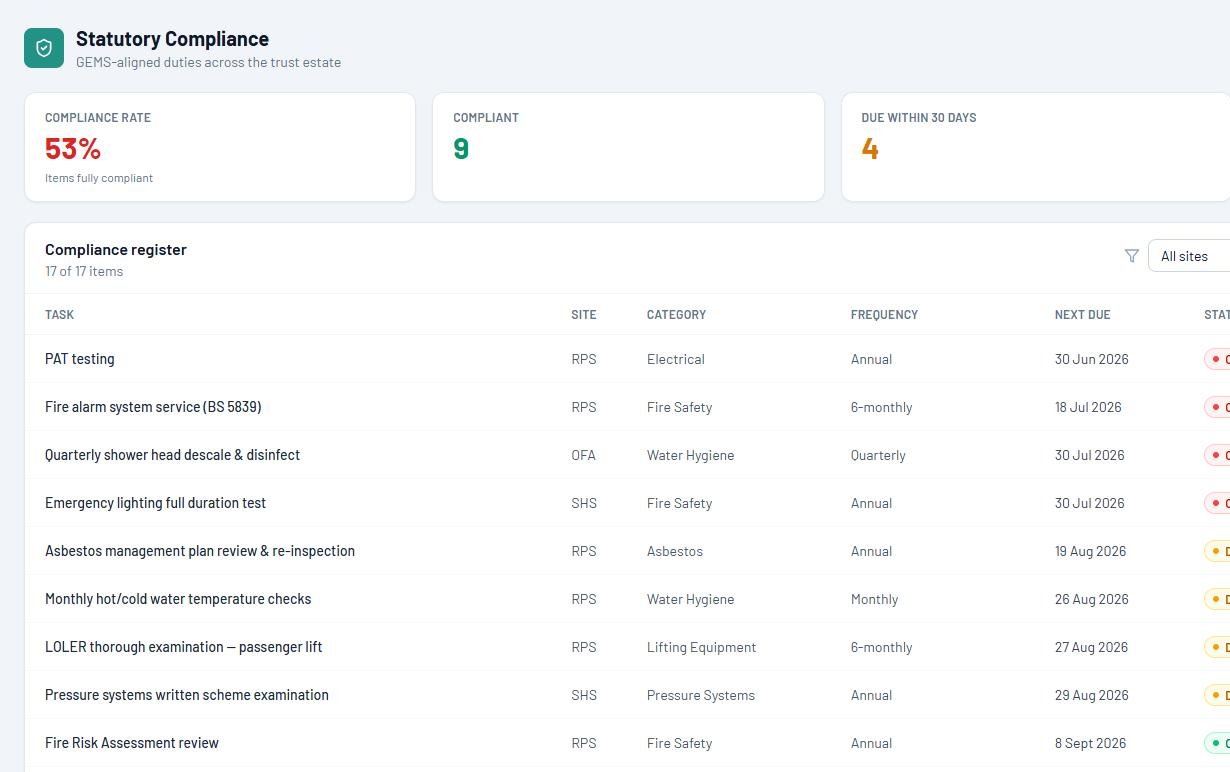
| Safety & statutory compliance | Every recurring duty (fire, asbestos, water, gas, electrical, lifts) done on time, with certificates and actions retrievable on demand | Contractor portals, filing cabinets, a spreadsheet per site, inboxes |
| Condition | A condition picture that is current, prioritised and costed, so decisions are made on data, not on who shouts loudest | The last condition survey, ageing unnoticed; job sheets that never fed back into the picture |
| Resources | Maintenance and capital spend traceable against the plan, with reactive costs understood rather than absorbed | The finance system, in categories the estates team didn't choose |
The exact return format sits with the DfE; this table is about the evidence base, which is the part you control and the part that takes longest to fix.
Five moves before the first return
- Name the owner now. One person accountable for the return, usually the estates lead or COO, with the board told the date it's coming. The first return fails most often as an ownership problem, not an evidence problem: everyone assumed someone else was assembling it.
- Run a dry pass against the standards this year. Self-assessing against the Estate Management Standards has been recommended practice since long before it was a return. Do it once voluntarily and the mandatory version becomes an update, not a discovery exercise, and the gaps you find get a year of runway instead of a fortnight.
- Pull the statutory evidence into one place. This is the heaviest lift and the highest-value one. Every certificate, inspection record and open action, findable by site and by duty: the statutory checklist is the list to work through. If the fire risk assessment review, the five-yearly EICR and the asbestos re-inspection each take a morning to locate, the return will take weeks.
- Refresh the condition picture. If the last condition survey predates the last two winters, it is describing a different building. Even a structured walk-through with photos, dated and filed against the site, beats a professional survey nobody can find.
- Put the estate on the board's calendar. The standards treat governance as part of estate management. A short, regular estates item (compliance position, condition risks, spend against plan) means the return's governance answers write themselves, and the board isn't hearing about the estate for the first time when they're asked to sign the return off.
Make the return a lookup, not an investigation
Every question the return asks is a question about records you already generate: inspections done, certificates issued, faults found, actions closed, money spent. The difference between a hard return and an easy one is whether those records were kept somewhere retrievable as the year happened, or need reconstructing from inboxes and contractor portals every autumn.
That's the case for running the estate on one system rather than a drawer of spreadsheets: day-to-day records kept in one place mean the return starts from your evidence rather than a blank form. It's the same argument our statutory compliance software guide makes for inspections week to week, and the same evidence base serves auditors, insurers and Ofsted, not just the DfE.
That is the thinking behind the standards position in EstateProof: rather than ask you to score yourself against the six pillars, it works the score out from the records (the duty that is in date, the certificate that is filed, the plan that is held) and recalculates it every night as the year happens. A pillar with no evidence behind it is never claimed, so the position is honest on day one and the gaps it shows are the ones worth spending the year closing. Come the return, the answer is already assembled.
Where does your estate stand today? The three-minute assessment scores the gaps, and the annual compliance calendar shows where the year's evidence should be coming from.
The self-assessment return: the questions that come up
When does the self-assessment return become mandatory?
From autumn 2026, under the Education Estates Strategy published in March 2026. Responsible bodies (trusts, local authorities, governing bodies) will submit an annual self-assessment of their estate management against the DfE's Estate Management Standards. Until now, assessing yourself against the standards was strongly recommended; the change is that it becomes a return you submit, on a schedule you don't set.
What do the Estate Management Standards actually cover?
Broadly: how the estate is led and governed, whether there is a current strategy and asset management plan, how safety and statutory compliance are managed and evidenced, how condition is understood and prioritised, and how the money, both maintenance and capital, follows the plan. It is less a technical inspection than a test of whether the organisation knows its estate and can prove it.
Who should own the return in a trust?
One named owner, usually the estates lead or COO, with the board sighted on the result, because the standards treat governance as part of estate management, not an audience for it. The mistake to avoid is treating it as a form-filling task for whoever has capacity in the autumn: the answers draw on compliance records, condition data, budgets and strategy documents that sit with different people, and assembling those takes weeks the first time.
What is the single best preparation you can do now?
Get your day-to-day records into one retrievable place before the first return, so the questions become lookups rather than investigations. A self-assessment drawn from live records (inspections logged as they happen, certificates filed against the site, actions tracked to closure) takes a fraction of the time of one assembled from folders and inboxes, and the same evidence base serves Ofsted, auditors, insurers and the next return.
Start the return from your evidence, not a blank form
EstateProof keeps the day-to-day records (inspections, certificates, actions) in one place in your school's own Microsoft 365, so the paperwork season finds you ready. Call 020 4558 7729 or email info@estateproof.co.uk.