Gas safety in schools: the annual cycle, explained
Gas safety is the compliance duty with the clearest rulebook and the least room for improvisation: the Gas Safety (Installation and Use) Regulations 1998 say who may touch the system (a Gas Safe registered engineer, and nobody else), and the annual service-and-check cycle does the rest. What actually goes wrong in schools isn't the boiler house; it's the edges: the kitchen, the science labs, the caretaker's house with its own separate legal duty, and the certificate that arrived by email and was never filed anywhere findable. This guide walks the whole estate.
Where gas lives in a school, and what each spot needs
The boiler room is the easy part: it's on the contract. The regime is only complete when the edges are on it too.
| Where | What's there | The regime |
|---|---|---|
| The plant room | Boilers, water heaters, pipework, flues | Annual service and safety check by a Gas Safe registered engineer, per appliance, records filed by site |
| The kitchen | Commercial catering appliances, ventilation interlock | Annual checks by an engineer qualified for commercial catering; the interlock that cuts gas when extraction fails is part of the check, not an optional extra |
| Science labs & DT | Bench taps, gas points, isolation valves | On the annual inspection; staff know the room's isolation point; unused points capped rather than trusted |
| The caretaker's house / boarding | Domestic appliances in let accommodation | Landlord duty: annual safety check per appliance and flue, CP12 record issued, kept at least two years. A separate legal obligation with a fixed interval |
| Everywhere | The emergency control valve; people | Site team knows where the valve is and the 0800 111 999 drill; CO alarms where the risk assessment calls for them, tested on the routine walk |
One visit, several records
A single annual gas visit generates more distinct evidence than almost any other duty: the safety check per appliance, the service record, any defect notices, the remedial completions, and in let accommodation, the CP12 with its own retention rule. The regime breaks when those land as PDF attachments across two inboxes and a contractor portal, because next year's question isn't "did the visit happen" but "show me last year's check for that appliance".
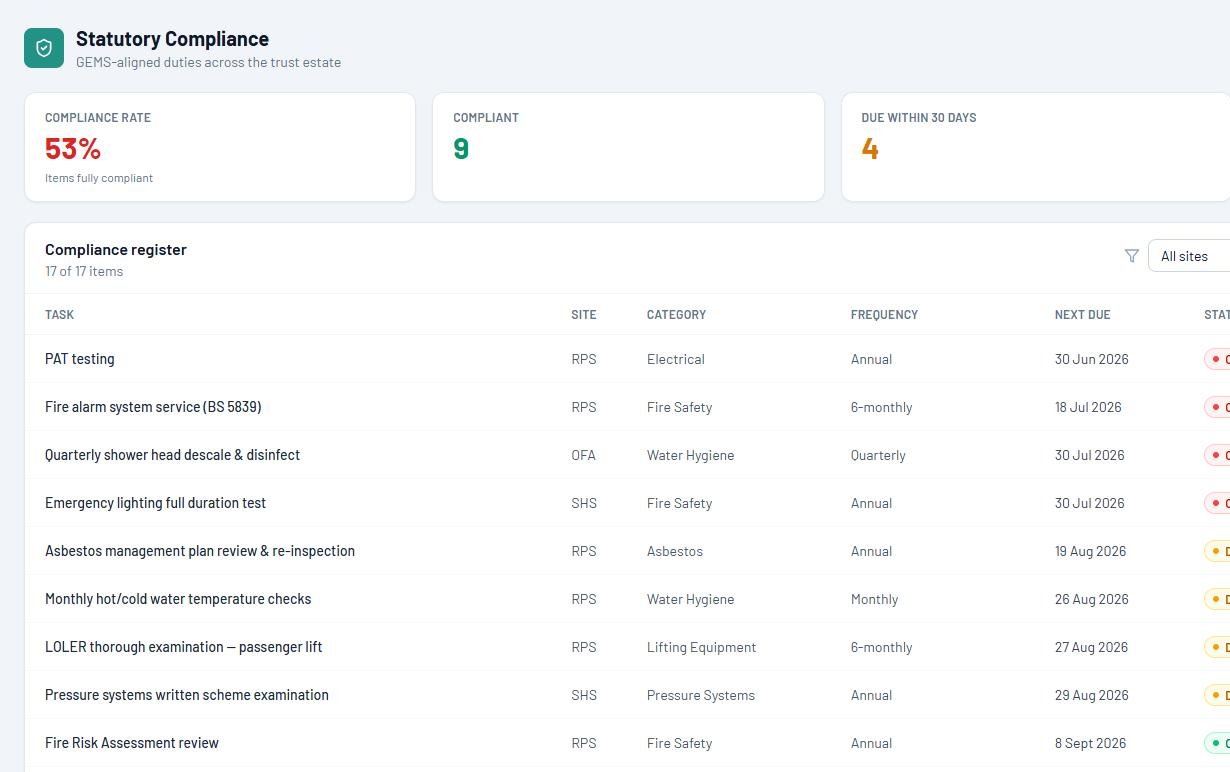
Filed against the site as they arrive, certificate attached, defects raised as jobs, jobs tracked to closure, the gas file becomes a lookup, which is the standard the whole statutory checklist works to. It's the same close-out discipline the EICR guide makes for electrical: the visit is the easy half; the trail is the compliance.
For where the annual gas visit anchors best in the year, most schools use the summer, for obvious reasons. The annual compliance calendar makes the case for August bookings made in May.
Gas safety: the questions that come up
What does the law actually require of a school?
The Gas Safety (Installation and Use) Regulations 1998 require employers to keep gas appliances, installation pipework and flues in a safe condition, and they make one bright-line rule: only a Gas Safe registered engineer may work on any of it. The regulations don't hand schools a fixed interval for the non-domestic estate, but annual servicing and safety checks, in line with the manufacturer's instructions, are the established benchmark that risk assessments, insurers and auditors work to.
Is a boiler service the same as a gas safety check?
No, and the difference matters on paper. A safety check confirms an appliance is safe to operate: combustion, ventilation, flue, safety devices. A service is maintenance to the manufacturer's schedule: cleaning, adjustment, parts. Schools usually buy both in one annual visit, which is fine, but the record should show both were done, per appliance, because 'the boilers were serviced' does not by itself evidence a safety check.
What about the caretaker's house or boarding accommodation?
That's where the rules sharpen. If the school or trust lets residential accommodation (a caretaker's house, staff flats, boarding), it carries landlord duties: an annual gas safety check on each appliance and flue with a record (the CP12 certificate) issued, kept for at least two years and given to the tenant. It is the one part of school gas safety with a legally fixed interval, and it is the part most often missed because it sits outside the main site contract.
What should we do if someone smells gas?
Treat it as an emergency, not a maintenance request: ventilate if it is safe to do so, don't operate electrical switches, evacuate the affected area, shut off the supply at the emergency control valve if trained to, and call the National Gas Emergency line on 0800 111 999 before anything else. Then log the incident and what was done: the follow-up record is part of the regime too, and every member of the site team should know where the emergency control valve is before the day they need it.
Every appliance, every certificate, one file
Annual checks scheduled, certificates filed against the site, defects tracked to closure, in your school's own Microsoft 365. Call 020 4558 7729 or email info@estateproof.co.uk.