Legionella in schools: who does what, in plain English
Legionella management suffers from a translation problem: the guidance, ACOP L8 and HSG274, is written for water treatment specialists, but most of the actual work is done by a caretaker with a thermometer. This guide translates: what the risk assessment is, what the written scheme of control contains, which numbers matter at the tap, who holds which responsibility, and why a school's six-week summer break makes this duty more demanding here than in almost any other building. As ever: a working explainer to make you a sharper client of your assessor, not a substitute for one.
Who does what
Legionella control fails most often at handover points, so the roles matter as much as the tasks.
| Role | Who, in a school | What they own |
|---|---|---|
| Duty holder | The employer, trust, local authority or governing body | The risk itself: ensuring assessment, scheme and resources exist. Not delegable by hiring a contractor. |
| Responsible person | A named, competent individual, often the estates lead | Running the scheme day to day; knowing the system; acting on findings |
| Competent assessor | Usually an external specialist | The risk assessment and its reviews; the schematic of the system |
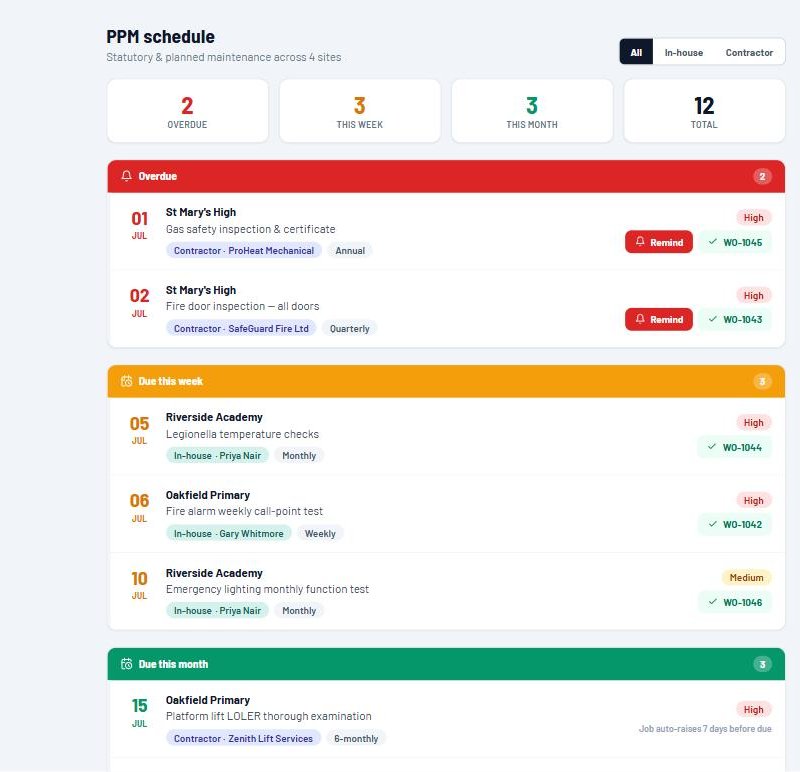
| Site team | Caretakers and site staff | The routine: monthly sentinel temperatures, low-use flushing, quarterly showerhead descale, logged every time |
| Contractors | Water hygiene firms | Tank inspections and cleaning, chlorination, remedial works, with certificates filed |
The regime, in five lines
Keep water out of the growth band. Legionella multiplies between roughly 20°C and 45°C. The whole regime is temperature segregation: hot stays hot, cold stays cold, and nothing sits still for long.
Hot: stored at 60°C or above; reaching at least 50°C at the outlet within a minute of running. Cold: below 20°C after running. Monthly: checks at designated sentinel outlets, the furthest and nearest points that prove the whole system, logged with readings, not ticks. A number in the danger band is a finding to action that day, not a cell in a spreadsheet.
Movement: low-use outlets flushed weekly so no dead leg sits warm and still; showerheads cleaned and descaled quarterly; tanks inspected and the system's schematic kept current so nobody manages pipework they don't know exists.
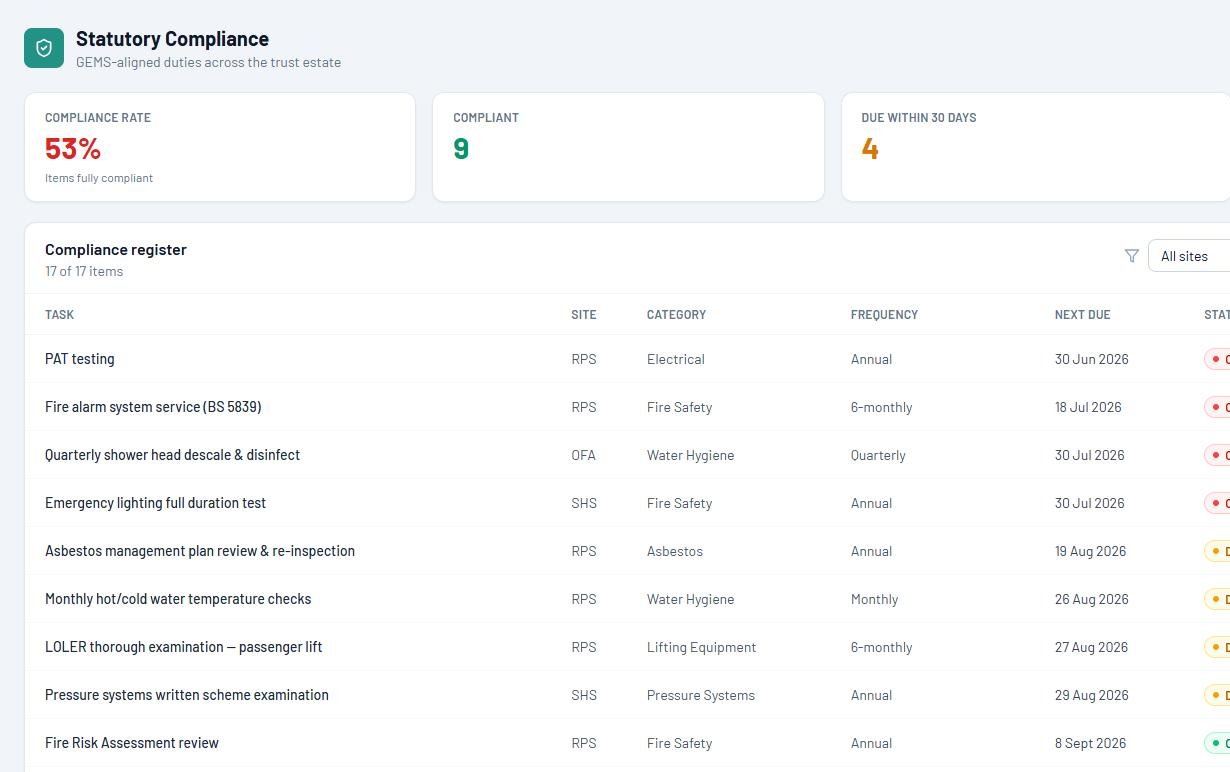
The record: the risk assessment, the written scheme of control, and the logs that prove the scheme runs. Retrievable on demand: the standard every duty on the statutory checklist shares.
The six-week problem
Most buildings never stop using water. Schools stop twice a year, and a warm, still system through August is close to ideal growth conditions, right before a thousand people return to it. That's why holiday flushing regimes and the September restart routine matter more here than in office blocks, and why "the caretaker's on leave in August" is a risk-assessment finding, not a rota detail.
It's also the duty where drift hurts fastest: a monthly check that slides to six weeks through the holidays is a gap in exactly the wrong place. The schedule has to keep running when the building is empty, which is an argument for a system that raises the jobs and flags the gaps regardless of term dates, made fully in our planned maintenance software guide. The annual compliance calendar covers where the rest of the year's anchors belong.
Legionella in schools: the questions that come up
Does every school need a legionella risk assessment?
Yes. Any building with a water system carries the duty, and schools tick most of the risk boxes: stored hot water, long pipe runs, showers, outside taps, and six-week occupancy gaps. The assessment must be suitable, sufficient and kept under review, reviewed regularly and whenever the system or its use changes, not filed and forgotten.
What are the temperature rules in plain terms?
The bacterium multiplies between roughly 20°C and 45°C, so the regime keeps water out of that band: stored hot water at 60°C or above, reaching at least 50°C at outlets within a minute of running; cold water below 20°C after running. Monthly checks at designated sentinel outlets prove the regime is holding, and a reading in the danger band is a finding to action, not just a number to log.
Why are the school holidays the danger period?
Stagnation. Six weeks of little or no flow through a warm building is close to ideal growth conditions, which is why low-use and holiday flushing regimes matter more in schools than almost any other building type, and why the September restart, with full occupancy returning to a system that sat warm and still all summer, is the moment the paperwork protects people.
Who actually does what in a school?
The duty holder (the employer, trust, local authority or governing body) owns the risk; a named responsible person runs the scheme day to day; a competent assessor produces and reviews the risk assessment; and the site team delivers the routine (monthly sentinel temperatures, flushing low-use outlets, quarterly showerhead cleaning), with every action logged. Contractors handle tank inspections, chlorination and remedial works.
A regime that runs through the holidays
See the water hygiene rhythm (readings logged, out-of-range flagged, contractors chased) running on one set of records in your school's own Microsoft 365. Call 020 4558 7729 or email info@estateproof.co.uk.