Lifts, hoists and LOLER: the six-month rule, explained
LOLER is the duty schools most often discover they had after the equipment list grows: the passenger lift is on the contract, but the mobile hoist in the hygiene room, the slings in the cupboard, the dumbwaiter behind the kitchen and the stage rigging in the hall all carry the same regulations, and the ones that lift people run on a six-month examination cycle that no annual contract covers. This guide translates the Lifting Operations and Lifting Equipment Regulations 1998: what counts, who examines it, how the examination differs from the service visit, and the close-out trail when a report lands with a defect in it.
What counts, and how often it's examined
The interval follows one test: does it lift a person, or is it an accessory used for lifting? Six months. Goods only? Twelve. A written examination scheme from a competent person can set different intervals, but that scheme is itself a document to hold on file.
| Equipment | Where it hides in a school | Cycle |
|---|---|---|
| Passenger lifts | The obvious one, usually already on an insurer's schedule | 6-monthly |
| Platform & stair lifts | Accessibility additions, often installed later and missed off the original list | 6-monthly |
| Hoists & slings | Hygiene rooms and SEND provision; mobile hoists move between rooms and slings are accessories in their own right | 6-monthly, per item |
| Stage & hall equipment | Rigging, winches and lifting bars in halls and drama spaces | 6-monthly where people could be beneath or on the load; per the scheme otherwise |
| Dumbwaiters & goods lifts | Kitchens and split-level blocks | 12-monthly |
| Workshop lifting kit | Engine hoists and vehicle lifts in DT or maintenance areas | 12-monthly (6-monthly if a person is ever raised) |
Alongside LOLER, the same equipment needs routine maintenance under PUWER: the service contract. Examination and servicing are separate duties with separate evidence.
The examination is not the service
Most schools have a lift company on contract and assume the box is ticked. The thorough examination is a different thing done by a different party: a competent person with genuine independence, typically an engineer surveyor from the insurer's inspection arm, producing a report of thorough examination, on a cycle the regulations set. A beautifully serviced lift can fail its examination; a passed examination doesn't do the maintenance. Two regimes, two contracts, two records, and both belong on the register with their own due dates.
The defect path is where LOLER shows its teeth: a defect with existing or imminent risk of serious injury takes the equipment out of use immediately, and the examiner notifies the enforcing authority directly. The school's job is the close-out trail: report filed against the equipment, defect raised as a job, repair evidenced, back-in-service noted. It's the same discipline the EICR guide describes for electrical, on a faster clock.
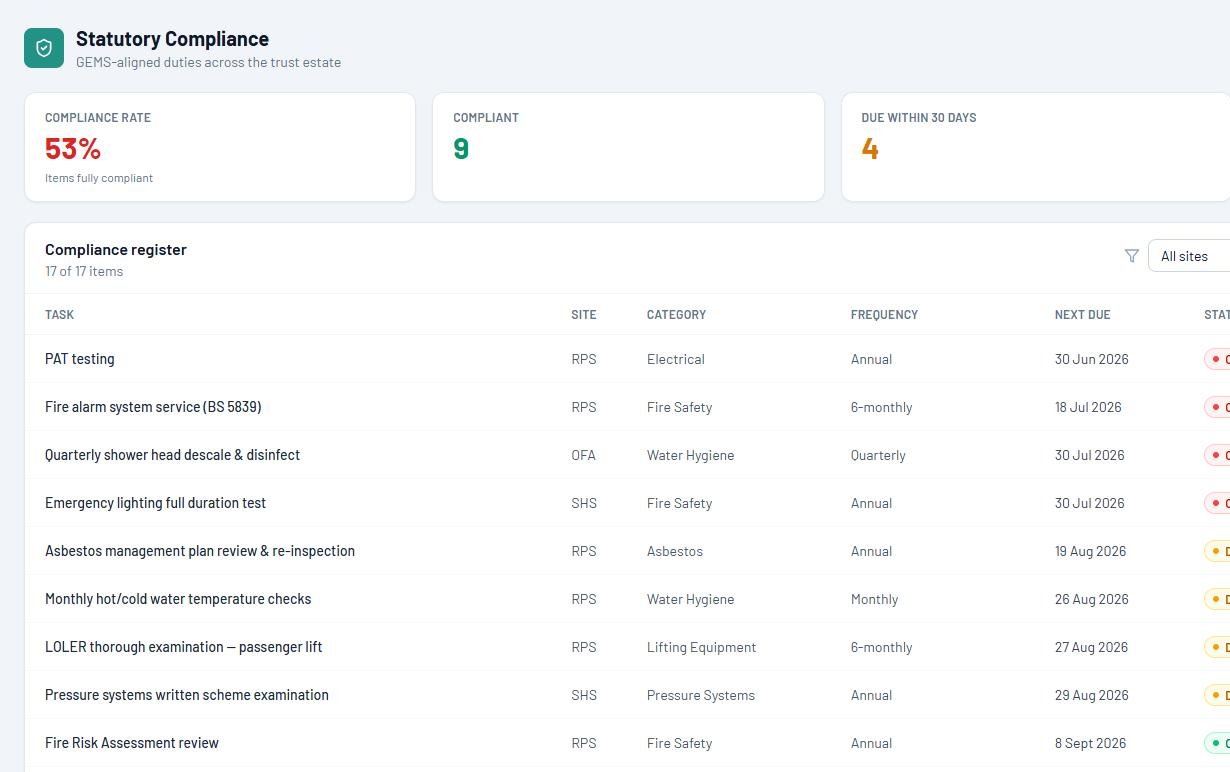
Six-month cycles are also the ones calendar drift punishes hardest: a slipped booking eats a third of the interval before anyone notices. That's the argument the annual compliance calendar makes, and the printable checklist keeps the whole rhythm on one sheet.
LOLER: the questions that come up
What does LOLER require, in one sentence each?
The Lifting Operations and Lifting Equipment Regulations 1998 require lifting equipment to be strong and stable enough for its use, positioned and installed to minimise risk, used safely by competent people, and (the part that drives the calendar) thoroughly examined by a competent person at set intervals: every six months for equipment that lifts people and for lifting accessories, every twelve months for other lifting equipment, or to a written examination scheme drawn up by a competent person. Day-to-day maintenance sits alongside under PUWER, the general work equipment regulations.
What counts as lifting equipment in a school?
More than the passenger lift: platform lifts and stair lifts, hoists for pupils with mobility needs, including mobile hoists and their slings, which are accessories on the six-month cycle; dumbwaiters and kitchen service lifts, stage and hall equipment that raises loads, and vehicle lifts in any DT or maintenance workshop. The person-or-thing test sets the interval: anything that lifts a person, and any accessory used for lifting, is six-monthly; goods-only equipment is twelve-monthly.
Who does the thorough examination, and is it the same as servicing?
A competent person who is sufficiently independent and impartial, in practice usually an engineer surveyor from your insurer's inspection arm, which is why many schools know it as the insurance inspection. It is not a service: the thorough examination is an inspection that produces a report; servicing is maintenance under a separate contract, usually with a lift company. A serviced lift can still fail its examination, and an examined lift still needs its maintenance visits: two regimes, two records.
What happens with the report, especially a defect?
The report of thorough examination goes on file per item of equipment, and its defects are not advisory: a defect involving existing or imminent danger of serious injury means the equipment comes out of use until it is fixed, and the examiner reports it to the enforcing authority themselves. Time-limited defects carry a date the fix must be done by. The record to keep is the familiar close-out trail: report filed, defect raised as a job, repair evidenced, equipment back in service, per lift, per hoist, per sling.
Every examination, every report, on the register
Six and twelve-month cycles tracked per item, reports filed against the school, defects raised as jobs and closed with evidence, in your own Microsoft 365. Call 020 4558 7729 or email info@estateproof.co.uk.